
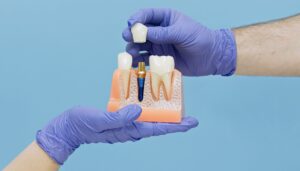
If you are seeking a lifelike, reliable way to replace missing adult teeth, you might be a good candidate for dental implants. Unlike dentures or bridges, these restorations are surgically embedded directly into your jaw and eventually fuse with the bone, which provides several unique advantages, including enhanced strength and increased longevity.
But you’re not alone if you’re unfamiliar with the vocabulary your dentist uses when discussing this procedure- after all, it can be quite complicated! Continue reading to learn more about several key terms to know to help you better understand what’s involved in getting dental implants.
Important Dental Implant Terms to Know
Below is a helpful glossary of terms to know that can help you better understand the conversation when you’re discussing this treatment with your provider.
- Abutment. This is a connector piece that is placed on top of the implant post in your jaw in order to hold your replacement tooth or teeth, such as a dental crown, bridge, or dentures.
- Bridge. Two implants can be placed to anchor one of these prosthetics, which contains the required number of artificial teeth positioned between two dental crowns to rebuild 1 to 4 missing teeth in a row.
- Ceramic. These restorations are often made from tooth-colored ceramic, such as porcelain, that can be customized to match the size, shape, and tone of your natural enamel for results that blend in beautifully with your smile.
- Crown. This is a small, customizable, tooth-shaped cap that can be fitted over an implant to replace a single missing tooth.
- Dentures. Several posts strategically placed in your jaw can hold specially designed dentures, rebuilding your entire arch more reliably than traditional dentures.
- Endosteal Implant. This is the most common type of dental implant and makes up more than 90% of implant procedures, and involves surgically placing small screws, cylinders, or blades into the jawbone.
- Eposteal Implant. These prosthetics may be more outdated than other options, though they can sometimes benefit patients at risk of high bone absorption, and sit on top of the jawbone below the gums.
- Implant. This fixture is made from resilient, biocompatible materials, such as titanium or zirconia, and is placed in or against your jaw to hold your replacement teeth.
- Osseointegration. Healing can take several months after your procedure because your jaw must produce enough new bone material to fuse with the implant post during this recovery process, but it is also why this treatment lasts longer and is more reliable than traditional bridges or dentures.
- Subperiosteal Implant. Like eposteal implants, these rest on the jawbone, though a portion protrudes above the gums to anchor your new teeth.
- Titanium. This lightweight metal resists corrosion, is unlikely to cause allergies, and isn’t rejected by the human body, but is strong enough to withstand the daily pressure of biting and chewing potentially for decades, making it an ideal material for implant posts.
- Zirconia. This is a type of durable ceramic that can be used in place of titanium, especially for patients who may have a rare allergy to the metal material.
Hopefully, understanding these keywords can help you discuss your treatment plan with your dentist in more detail during your consultation, so you know what to expect from the procedure!
Meet the Author
Dr. JD Hansen is passionate about helping people improve their general well-being by enhancing their dental health. He earned his dental degree at the University of Louisville in 2012, then completed a General Practice Residency at the University of Utah, where he received in depth training for more advanced procedures, such as dental implants. Today, he offers a comprehensive menu of services using state-of-the-art technology to people of all ages for more accurate, long-lasting results. You can request an appointment on the website or by calling (801) 719-2113.